
 2 minute read
Why High-Trust Brands Are Adding Language Governance
As digital channels expanded, so did the volume of content moving through them.
Emails, landing pages, social posts, product updates often written quickly, reviewed lightly, and published under pressure.
Many brands didn’t notice a problem at first.
Engagement metrics were holding. Output was consistent. Visibility was steady.
But over time, a different signal began to emerge.
Audiences felt harder to reach.
Internal teams felt unsure about tone.
Writers described second-guessing their words not because they lacked skill, but because expectations felt unclear and constantly shifting.
This wasn’t a performance issue. It was a language governance gap.
The Hidden Cost of Ungoverned Language
Most organizations already have brand guidelines. Fonts, colors, values, positioning statements.
What they often don’t have is a shared way to assess how language lands especially when content is produced across teams, tools, and timelines.
In practice, this can look like:
- Urgency creeping into copy meant to feel supportive
- State-based experiences becoming identity labels
- “Helpful” language that subtly pressures action
- Tone debates that rely on opinion instead of shared criteria
No one intends harm. The issue is accumulation.
When language isn’t governed, it inherits the incentives of the systems producing it; speed, certainty, optimization whether or not those incentives align with the brand’s values.
A Different Question
S.Y.N.Cvoice™ was built around a single reframing: What does this language do to the person reading it?
Not Will it convert?
Not Is it confident enough?
Not Does it sound authoritative?
But whether it supports:
- agency
- clarity
- nervous-system regulation
- choice
This shift doesn’t require rewriting a brand’s voice. It requires reviewing language before publication with care.
What Language Governance Looks Like in Practice
When brands begin using a language governance layer, the change isn’t dramatic, it’s subtle.
-
Content is still written by humans.
-
AI tools may still assist with drafting.
-
Deadlines still exist.
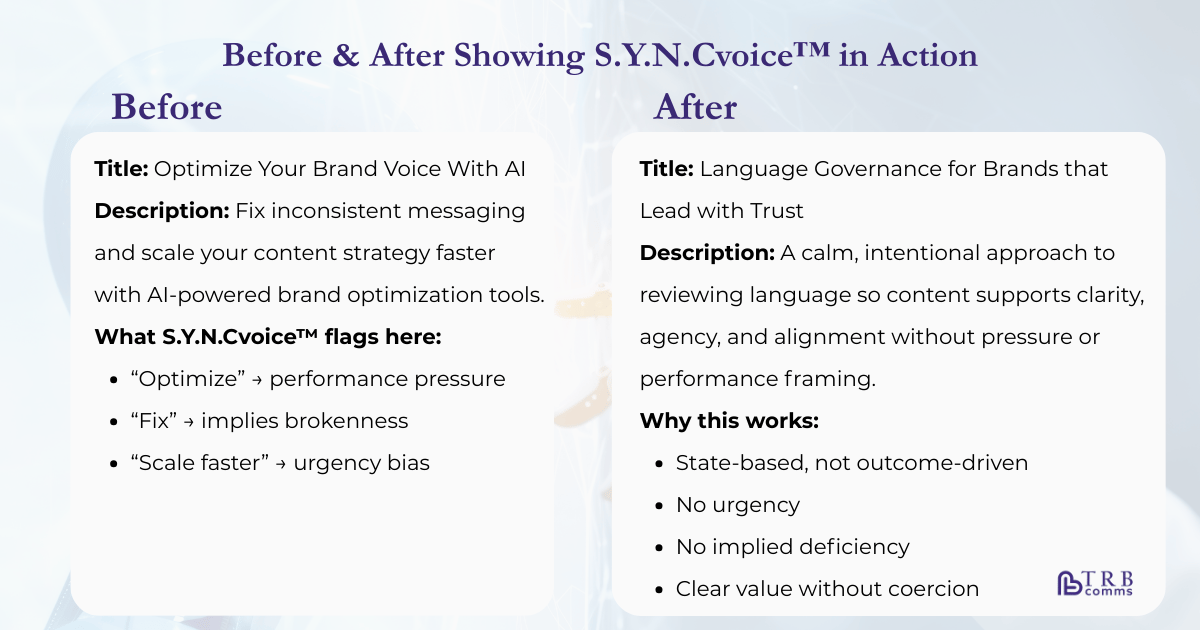
What changes is the final gate. Before content goes live, it’s reviewed for:
- pressure signals
- urgency cues
- fixing or rescuing language
- identity framing
- tone alignment with stated values
When signals are clear, guidance is offered. When signals are mixed, the system pauses. When confidence is low, it asks for context instead of guessing. Nothing is forced. Nothing is labeled as “wrong.” The result is fewer reactive edits and more intentional decisions.
What Brands Begin to Notice
Brands using language governance often describe:
-
Cleaner approval cycles
-
Fewer internal tone disagreements
-
Reduced reliance on multiple overlapping tools
-
Greater consistency across channels
-
Increased trust with sensitive audiences
Not because content became more persuasive but because it became more regulated.
1. Writers report feeling steadier.
2. Editors feel clearer about what they’re looking for.
3. Leadership feels less exposed to reputational risk.
Language becomes something the organization cares for, not just produces.
Why This Matters Now
As AI-assisted content becomes more common, the question is no longer whether brands can produce enough language. It’s whether they can remain responsible for its impact.
Language governance doesn’t slow teams down. It helps them move forward without overriding signals, internal or external. And in high-trust spaces, that distinction matters.
Before publication, S.Y.N.Cvoice™ asks one question:
Does this language help someone listen to themselves without pressure?
When brands adopt that question as a standard, content changes, not in style, but in integrity.

.png)